Reserved Labs + Workshop Series
Program Overview
Hands on lab experiences for your classroom
Enhance your field trip to OMSI with one of our signature experiences!
Choose from hands-on lab workshops, assemblies, and career discovery tours. Each program provides students with real-world STEM experiences designed to build student’s skills and inspire them to pursue STEM career pathways. Our programs are carefully designed for specific age and grade levels to align with Next Generation Science Standards and led by OMSI’s incredible Science Educator team.
These programs do not include museum admission. If you are also wanting to explore OMSI’s exhibit halls during your visit, you will need to add museum admission tickets onto your field trip reservation.
Need Help Planning?
For more information and to begin booking your program, please contact our registration team at Register@OMSI.edu or (503) 797-4661, or Request Information.
Choose from six different workshop topic areas!
Life in Action: Dissection + Microscope Workshops
Get up close with the living world! Students can explore animal and plant anatomy, investigate adaptations, or discover the microscopic details of the world around us.
Discover the amazing adaptations that make owls expert hunters! By observing and handling real artifacts from owls and other birds, students learn about the different adaptations that make owls survive and thrive in their environment. This experience includes an owl pellet dissection, where students can discover what owls eat and take home their findings.
Microscopes open up a world of details too small to see with our naked eyes. In this lab, students explore the different parts of a microscope to understand how they work together to magnify tiny objects. Each student practices their microscope skills by creating slides, making observations, and recording and analyzing what they discover.
Students investigate how structure supports function by exploring the anatomy of a squid. Through careful observation and guided dissection, students examine both internal and external structures. Students build science skills by making observations, using tools appropriately, and discussing how form and function are related across living organisms. Each student (or pair) works directly with a real squid specimen.
Ever wonder what’s inside an eyeball? In this lab, students take a look at one of the body’s most amazing organs. Students explore the structures of the eye and discover how the eye and brain work together to create vision. Then, working in small groups, students identify these structures through careful observation and dissection of a preserved cow’s eye.
Chemistry Exploration Workshops
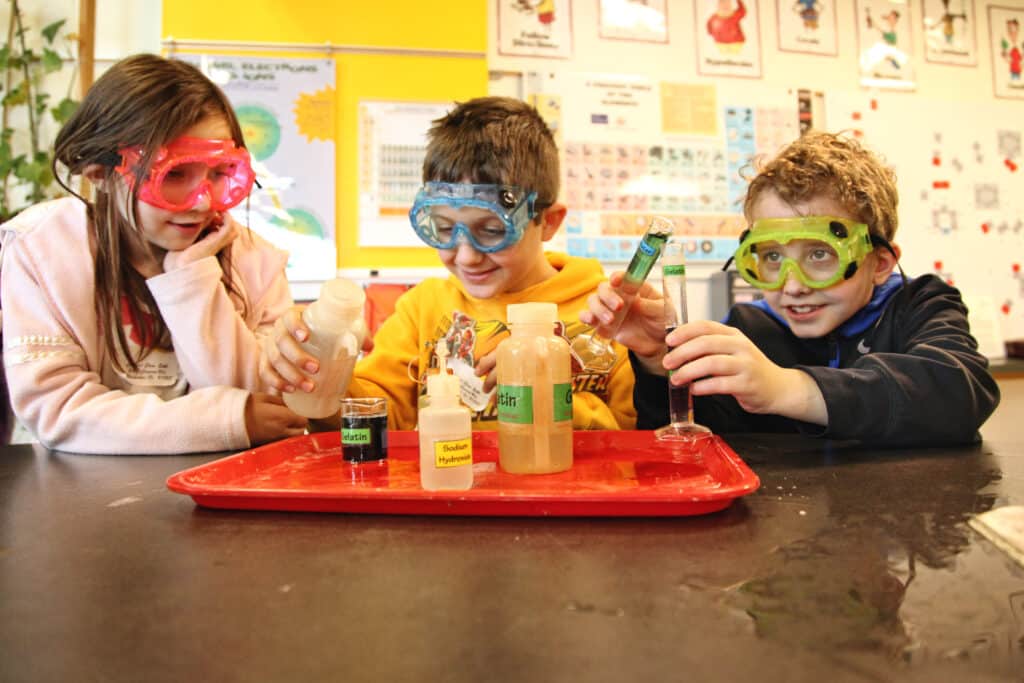
Explore the exciting world of chemistry through interactive, hands-on experiments. Students will learn the foundations of chemistry lab safety, make observations and predictions, and see chemistry in action.
Fire up your imagination with the wonders of chemistry! Early learners learn about solids, liquids, and gasses: What makes them different, and why do they behave the ways they do? In small groups, students complete three different hands-on chemistry experiments to find out!
Uncover color changes, heat flashes, eerie glows, and other signs of chemical reactions. Students complete up to six hands-on experiments and view exciting demonstrations as they learn what chemical reactions are and how chemists observe, test, and explain chemical reactions.
Learn how forensic scientists investigate clues left at a crime scene with blood typing, dusting for fingerprints and chromatography. Students complete up to six hands-on experiments and view exciting demonstrations as they connect chemistry concepts to real investigative techniques.
Scientists are in a race to understand and protect Earth’s water, land, and air. Students complete up to six hands-on experiments and view exciting demonstrations as they understand current environmental challenges and discover possible solutions.
Explore how atoms and molecules pack together to make up matter, the “stuff” of the universe, with fizzing solutions, DIY batteries, starch slime and more. Students complete up to six hands-on experiments and view exciting demonstrations as they explore the fascinating world of chemistry.
Design Challenge Workshops
Through hands-on design challenges, students experience the engineering process firsthand. In order to solve real-world problems, students design, test, and refine their ideas. While developing critical engineering skills, students discover how engineers use innovation to improve lives and solve problems.
Hands-on challenges give students the opportunity to think like engineers as they solve problems with a variety of materials. Students explore solutions, problem-solve, and stretch their engineering process and design skills.
How does a seesaw work? What makes wheels on a bike go round? How can you lift a lion? We will learn the answers to these questions by exploring simple machines such as gears, wheels, pulleys, levers and inclined planes and how they make our lives easier.
Through observations, hypothesis-building, and hands-on testing, students explore the science behind earthquakes before applying their knowledge to discover how engineers design structures to withstand them. Students make observations, identify patterns, and collect data while experimenting with a variety of models to build earthquake-resistant structures.
Through guided experimentation, students explore how light energy is transformed into electrical energy and how factors like angle and intensity affect energy output. They work collaboratively to build circuits, measure voltage, and design solar-powered systems, culminating in the challenge of powering a model building.
Students investigate how wind energy can be harnessed to generate electricity. Students explore how blade shape, angle, and design affect the efficiency of wind turbines. Working with a functional turbine, students measure electrical output using multimeters and apply the engineering design process to improve turbine performance and learn about solving real-world energy challenges.
Students investigate gravity, potential and kinetic energy, friction, and inertia by designing and engineering a mini roller coaster. Through a series of challenges, students design, test, and troubleshoot solutions that meet increasing criteria.
Can you help us send a marshmallow to space? Students learn about what it takes to make a space suit and why people need to wear them. Through fun experimentation, students work together to design and build a spacesuit for a marshmallow that connects function and structure to ensure the marshmallow survives in space.
Building a simple circuit with a battery, copper tape, and an LED introduces students to the foundations of electricity. Students engage in the engineering design process by planning, building, and troubleshooting a simple circuit using a battery, copper tape, and an LED. Students then use their completed circuit to make a piece of electric art they can take home with them.
Shipwrecked! You and your crew are trapped on a deserted island. Using physics knowledge and supplies left behind from the ship, students work in groups to build a circuit to power a light source and signal device, use magnets to create a functioning compass, and construct a life raft out of scraps to try and make it to safety.
Career Discovery
Curious about careers in STEAM, education, museums, and more? Discover the many ways people use their skills and passions to educate, inspire, and engage with their communities. Through hands-on activities and behind the scenes experiences, explore the diverse career pathways that exist at OMSI and beyond and the skills and steps needed to get there.
Get a unique tour of OMSI to explore different career pathways. Hear from OMSI staff across different areas and departments from the museum as they share about the elements of their work and the pathways that brought them to their role at OMSI. Tours can be general or tailored to explore a specific career path.
Step into the role of an experience designer and explore how science museum exhibits are designed to engage and inspire visitors. Through guided activities and interactive discussions, students will gain insights into the practices that OMSI’s experience design team uses to create impactful exhibits before exploring and analyzing exhibits throughout the museum.
Assemblies at OMSI
Science takes center stage for these large group presentations. OMSI’s assembly programs bring concepts to life with thought-provoking demonstrations and audience participation. Assemblies are designed for groups of 60-200 people.
This show has it all—solutions that instantly change color, giant piles of foam, great balls of fire and more! Students can see a variety of chemical reactions and learn how to recognize when chemical reactions are happening.
Students experience hot ice, floating fog and exploding liquid to explore the states of matter, their properties, and how they change from one form to another and back again. Your class will have a gas!
Homeschool + Workshop Series
Interested in a series of programs across multiple weeks? We have three standard workshop series. If you are interested in something more unique, please contact us.
How do plants grow and why are pollinators so important? How does food go from the ground to the grocery store? Why does it all matter? In this 5-week program, students will learn about important components of ecosystems and how they are connected.
Students will explore the concept of optics and magnification as they investigate the things that can only be seen under a microscope! Through hands-on specimen collection and observation, students will gain laboratory skills and learn different sample preparation methods.
Physics is everywhere and it’s all about how we use it! Join us in this series as we use our knowledge of the forces of nature to build and design circuits made with paper, roller coasters, and space suits.
Programing Questions?
If you are interested in something more unique, please contact our registration team to assist in your planning.
FAQ
Have questions? We have answers! For more information and to begin booking your program, please contact our registration team at Register@OMSI.edu or (503)797-4661
For Workshops and Tours, our maximum class size is 18 students. We highly recommend a minimum class size of at least eight students.
Our Assemblies have a minimum attendance of 60 and a maximum capacity of 200, including adult chaperones.
We require one adult chaperone for every five students grades K-8, and one adult for every ten students grades 9-12. Chaperones should expect to be involved with the students’ activities and helping them to follow directions and stay engaged.
Teen chaperones are welcome but do not count for the required adult-to-student ratio.
Programs are available from September through May.
Standard workshops and labs are offered Tuesdays through Fridays from 10 am to 11 am and from 11:30 am to 12:30 pm.
Assemblies are offered Wednesdays through Fridays from 11 am to 12 pm.
Workshop Series are offered on Wednesdays and Thursdays from 1 pm to 2:30 pm.
Please contact our registration team to discuss alternative time offerings. Please note that the museum is typically closed on Mondays during the school year.
Standard workshops are $140 per one–hour session.
Assemblies are $5 per student and no cost for adult chaperones for a one–hour show.
Workshop series are $1,200 for the five-week series ($240 per hour and a half session).
OMSI supports educators with Next Generation Science Standards (NGSS) requirements by providing corresponding programming, opportunities, and resources for them and their students. Reach out to learn more about specific ways that OMSI experiences align with and support science standards.
Yes! We would love to work with you to provide a program that meets your needs. We may be able to adjust single programs or create unique program series. Please contact our registration team to discuss customized programs.
Yes. Please contact our registration team if you would like to learn more about the content in each program to help you decide if a program is right for your student(s). The grades listed are what we recommend and the grade levels for which each program has been designed. However, you know your students best. If you believe that a student outside of the listed grade range will be appropriately challenged, you are welcome to register them for the program.